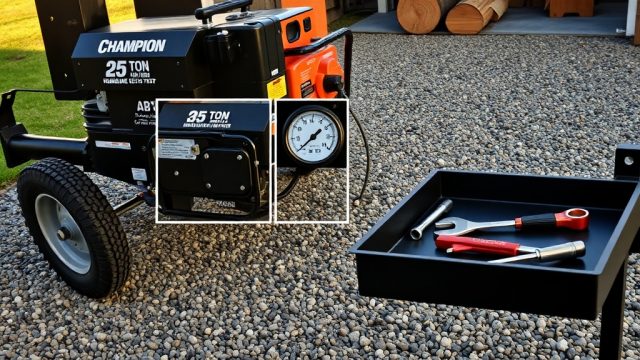
If you own a Champion 25-Ton log splitter and struggle with knotted, stringy, or twisted hardwood like elm, cherry, or gum, the factory wedge angle can turn a routine split into a frustrating jam. Modifying the wedge angle improves entry into stubborn grain, reduces hydraulic stall, and saves you time re-splitting partial logs. This guide walks you through safe wedge angle adjustment, prevention of wear, and calibration for Champion’s 25-ton hydraulic system.
Why Does Wedge Angle Matter for Knotty Wood on a Champion 25-Ton?
The wedge angle determines how aggressively the blade enters the wood. On Champion 25-Ton splitter, the standard wedge is typically around 25–27 degrees. That angle works fine for straight-grain oak or pine, but knotty wood often splays the log outward rather than splitting cleanly. A more acute angle (e.g., 20–22 degrees) gives the wedge a sharper leading edge, which slices through tangled fibers before they can bind. Conversely, a wider angle can stall the wedge on denser knots. The hydraulic pump on this Champion 25-Ton model delivers up to 2,700 PSI and a cycle time of about 12 seconds; optimal wedge geometry helps it maintain full force without losing travel momentum.
How Do I Measure the Current Wedge Angle on My Champion 25-Ton Splitter?
Before any mod, you need a baseline measurement. You’ll need an analog or digital protractor or a simple angle finder. Follow these steps:
- Safety first: disconnect the spark plug and release hydraulic pressure (cycle the splitter without the engine running).
- Place the wedge in the fully retracted position.
- Clean the wedge’s cutting edge with a rag and degreaser.
- Place the protractor’s base flat against the wedge’s back surface (not the cutting face).
- Read the angle relative to the splitter beam. For Champion 25-Ton, expect 25–27 degrees inclusive angle.
- If you have a wedge with a removable shoe, measure the shoe alone before reassembly.
A mismatch of more than 2 degrees from 25 degrees can explain repeated binding. Record your measurement for reference when modifying.
What Tools and Materials Do I Need to Modify the Wedge Angle?
You’ll need a few specialized items—Champion’s 25-Ton wedge is thick 1/2-inch steel, so grinding or filing requires the proper equipment.
| Tool/Material | Purpose | Estimated Cost (USD) |
|---|---|---|
| Angle grinder with 4.5-inch metal cutoff wheel | Remove steel from wedge face in controlled passes | $35–$60 |
| Magnetic protractor or digital angle gauge | Precise measurement during grinding | $20–$40 |
| Flat bastard file (10-inch) | Clean up burrs and fine-tune angle | $12–$18 |
| Safety glasses, gloves, and hearing protection | Personal protective equipment | $20–$30 |
| Engine degreaser and wire brush | Clean wedge before modification | $10–$15 |
| Welding clamp or vise grip | Secure wedge during work | $15–$25 |
| Paint marker or layout fluid | Mark desired angle line | $8–$12 |
Severity note: If you’re not comfortable with an angle grinder, consider having a welding shop perform the grind. Mistakes can ruin the wedge, requiring replacement cost of around $80–$120.
Step-by-Step: How to Modify the Wedge Angle on a Champion 25-Ton
This procedure assumes you have the tools listed. Work in a well-ventilated area away from flammable materials.
- Remove the wedge assembly — on most Champion 25-Ton models, the wedge is bolted to the beam with 2–4 bolts (typically 5/8-inch). Loosen with a breaker bar. Place the wedge in a bench vise with non-marring jaws.
- Mark your target angle — using a paint marker, draw a line on the wedge face that matches your desired new angle (e.g., 22 degrees). Use a templated cardboard piece if you want a clean guide.
- Grind the cutting edge — start with the angle grinder at a shallow pass along the line, removing roughly 1/16-inch per pass. Check progress frequently with the magnetic protractor. Aim for a flat, even bevel across the entire cutting face.
- File and deburr — once the angle approximately matches, switch to the flat file to smooth any grinding marks. Focus on keeping the edge straight and free of chips.
- Reinstall and test — bolt the wedge back on (torque to 50–60 ft-lbs for standard bolts). Cycle the splitter without wood first to ensure no binding. Then try a knotty log section you previously struggled with.
Note: If you over-grind and the angle becomes too acute (under 18 degrees), the wedge may be more prone to chipping on hard knots. In that case, weld a small bead of hardfacing rod to the edge and re-grind.
What Are Common Pitfalls When Modifying the Wedge Angle?
Several issues crop up regularly on the Champion 25-Ton platform. Here are the main ones to avoid:
- Uneven grind — if you remove more steel from one side of the wedge than the other, the split will veer sideways, causing each cycle to waste force. Measure across three points: top, middle, bottom of the wedge.
- Neglecting the wedge’s back support — the wedge isn’t just the edge; its rear face keeps the log stable. If you grind the edge too thin (less than 1/8-inch thickness at the tip), the wedge may bend under Champion 25-ton pressure. Maintain at least 3/16-inch tip thickness.
- Skipping hydraulic pressure adjustment — after wedge angle mod, you might want to fine-tune the hydraulic pressure to match the new cutting profile. For details, see our guide on Champion 25-Ton Log Splitter: Hydraulic Pressure Adjustment for Beginners.
- Ignoring drive belt tension — if the splitter bogs down more frequently after the angle mod (due to increased friction on certain types of wood), check belt tension. A loose belt slips under load. Our article Champion 25-Ton Splitter: Step-by-Step Drive Belt Replacement Guide covers belt replacement and adjustment.
What Owners Say About Wedge Angle Modification on Champion 25-Ton
Seasoned wood splitters who’ve performed this mod on Champion 25-Ton report a dramatic reduction in log jams. On the ArboristSite forums, user “FirewoodJim” noted: “I took my 25-ton Champion wedge from 26° down to 21°. Now I split knotty black locust that used to stop me every three logs. No more hammering chunks off.” Another owner, “MaineSplitter”, found that the mod made the hydraulic cycle more efficient: “The engine doesn’t strain as long on each split. I cut cycle time by maybe 1.5 seconds on average with knotty wood.” However, some caution: user “MountainWood” cautioned that after grinding, the wedge’s lifetime on very hard oak might shorten, with edge dulling occurring 20–30% faster. Regular sharpening with a belt sander every 3–5 cords is recommended. For noise reduction during operation, check out Champion 25-Ton Log Splitter: Noise Reduction Tips for Quieter Operation.
Frequently Asked Questions
Will modifying the wedge angle void my Champion 25-Ton warranty?
Yes, in most cases. Champion Power Equipment typically does not cover modifications to the wedge or beam. If your unit is under warranty, contact Champion support before performing any grinding. Many owners choose to wait until the warranty expires or buy a pre-modded wedge from third-party suppliers.
Can I reverse the wedge angle mod if I make a mistake?
Only if you remove very little material (e.g., 0.5 degrees). For larger changes, you would need to weld new steel onto the edge and re-profile it. In practice, most owners keep a backup wedge for standard splitting and mod a second wedge for knotty wood.
How do I know if my wedge angle is causing hydraulic cylinder damage?
If you hear a high-pitched whine from the pump during a stalled split, or if the cylinder seems to shudder, the wedge angle may be too blunt. Check our guide on Champion 25-Ton Splitter: Hydraulic Pressure Adjustment for Beginners to see if pressure is too high or low. Stalls create backpressure that can prematurely wear the pump piston.
Should I also clean carbon from the engine after modifying the wedge?
Yes. Engine carbon buildup can reduce horsepower, which is especially noticeable when a sharper wedge increases splitting speed. Follow Champion 25-Ton Log Splitter: Carbon Cleaning Guide for Engine Performance to keep the engine running cleanly.
What if a log gets stuck even after the angle mod?
Never force a jammed log with a hydraulic push. Use a splitting wedge or a sledgehammer to break the stuck piece. For safe procedures, see Champion 25-Ton Splitter: Safe Techniques for Clearing Log Jams.
How often should I sharpen the modified wedge?
For knotted wood, sharpen after every 4–6 cords. Use a belt sander with 60-grit ceramic belt; keep consistent edge angle. Test by cutting a piece of newspaper—the wedge should slice without tearing.