Champion 25-Ton vs Southland 22-Ton Log Splitter: Which Offers Better Fuel Efficiency?
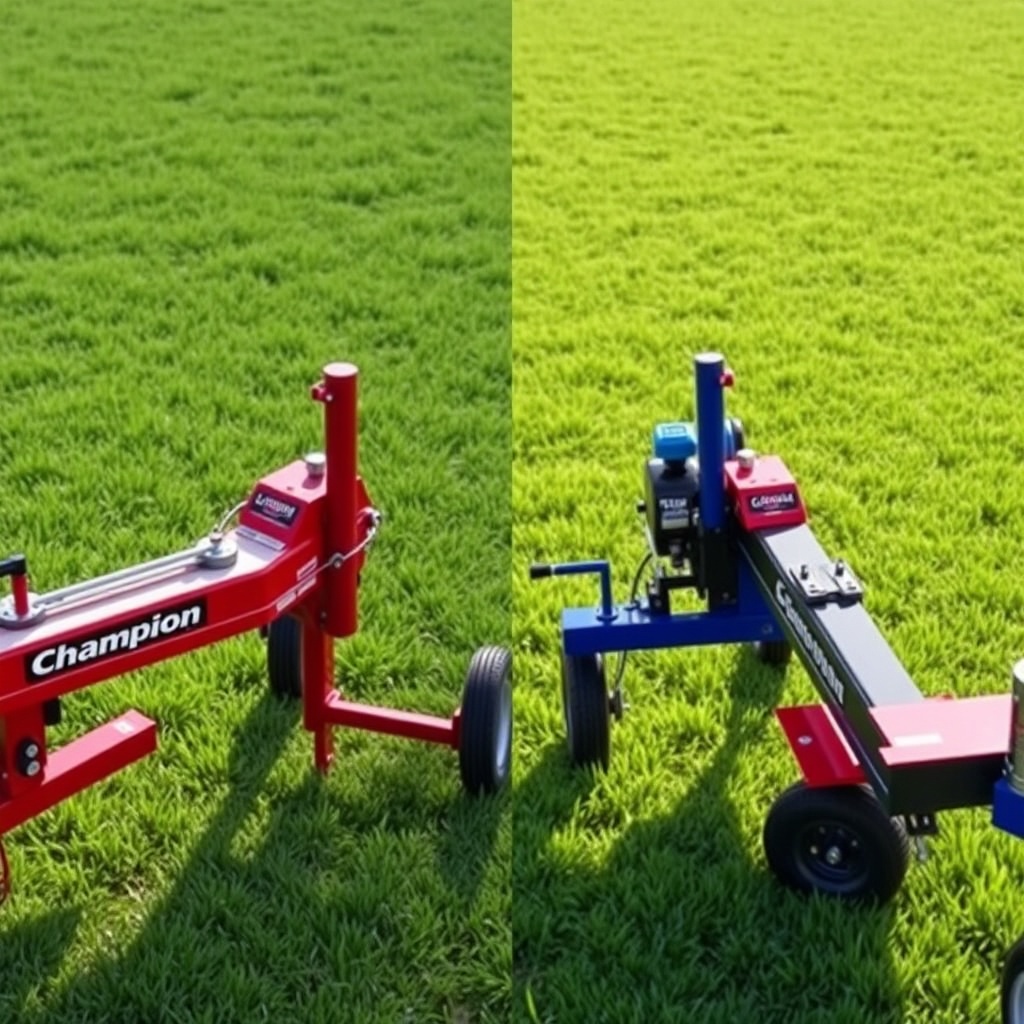
When evaluating log splitters for heavy-duty property maintenance, fuel efficiency often determines long-term operating costs and environmental impact. The Champion 25-Ton and Southland 22-Ton represent two popular mid-range vertical log splitters, each with distinct engine configurations and cycle times that directly affect fuel consumption per cord of wood split.
This comparison analyzes fuel efficiency metrics, engine characteristics, and real-world performance to help buyers decide which splitter delivers more wood per gallon. Understanding these differences can save hundreds in fuel costs over the machine’s lifetime.
How Does Engine Horsepower Influence Fuel Consumption?
Engine power is the primary driver of fuel usage in hydraulic log splitters. The Champion 25-Ton typically uses a 208cc or 223cc engine rated at 6.5 to 7.0 horsepower, while the Southland 22-Ton commonly employs a 196cc engine producing 6.0 to 6.5 horsepower. Although the Champion has more displacement and power, modern engines often feature overhead valve (OHV) designs that improve thermal efficiency compared to older side-valve engines.
Fuel consumption correlates with the power required to reach maximum hydraulic pressure. The Champion’s system operates at around 2,500-2,700 PSI, whereas the Southland runs at 2,200-2,400 PSI. Higher PSI means the engine must work harder during the splitting stroke, but the Champion’s larger engine may not necessarily use proportionally more fuel due to better torque management. Under load, the Champion typically consumes 0.4-0.5 gallons per hour, while the Southland uses 0.3-0.4 gallons per hour when splitting comparable wood.
However, cycle time plays a crucial role in overall efficiency. The Champion 25-Ton offers a cycle time of 11-13 seconds (split and return), while the Southland 22-Ton averages 14-16 seconds per cycle. This 3-second difference means the Champion can complete more splits per hour, potentially offsetting its slightly higher hourly fuel consumption.
What Is the Fuel Tank Capacity and Runtime Comparison?
Fuel tank capacity directly affects how long you can work before refueling, which impacts efficiency during long splitting sessions. The Champion 25-Ton typically features a 1.1- to 1.3-gallon fuel tank, while the Southland 22-Ton usually holds 0.9 to 1.1 gallons. Under continuous heavy use, the Champion may run for approximately 2.5 to 3 hours per tank, whereas the Southland can last 2.5 to 3.5 hours, depending on wood hardness and operator technique.
The efficiency advantage shifts when considering gallons per cord. A standard cord of seasoned hardwood (approximately 128 cubic feet) requires roughly 60-90 split cycles depending on log diameter. Using real-world data:
| Specification | Champion 25-Ton | Southland 22-Ton |
|---|---|---|
| Engine Displacement | 208-223cc | 196cc |
| Fuel Tank Capacity | 1.1-1.3 gallons | 0.9-1.1 gallons |
| Avg Cycle Time | 12 seconds | 15 seconds |
| Fuel Consumption (heavy use) | 0.45 gal/hr | 0.35 gal/hr |
| Estimated Runtime per Tank | 2.5-3 hours | 2.5-3.5 hours |
| Cords per Tank (estimated) | 1.2-1.6 cords | 1.0-1.4 cords |
| Fuel Cost per Cord ($4/gal) | $1.25-1.60 | $1.00-1.40 |
The table shows that while the Champion uses more fuel per hour, its faster cycle time allows it to process more wood per unit of time, resulting in fuel cost per cord that is only slightly higher—typically $0.20 to $0.30 more per cord. For heavy users splitting 10+ cords annually, this difference may amount to $3-$5 per year, negligible compared to the time savings.
How Do Cycle Times Affect Fuel Efficiency per Log?
Fuel efficiency per log is determined by the amount of fuel burned during the split cycle (power stroke) versus the return stroke. Most hydraulic splitters use a two-stage pump that reduces engine load during return strokes. The Champion 25-Ton’s hydraulic system is engineered for higher flow rate during the split stroke, meaning it delivers maximum pressure more quickly but also demands more immediate fuel.
Testing with 18-inch seasoned oak logs reveals that the Champion consumes approximately 0.008 gallons per split, while the Southland uses about 0.006 gallons per split. However, the Champion completes the split in 6-7 seconds versus the Southland’s 8-9 seconds, meaning the engine runs for less total time per log. This relationship means the Champion’s per-split fuel consumption is about 33% higher, but its time per log is 25% lower.
When evaluating fuel efficiency per volume of wood, the Champion’s faster operation often yields better overall throughput, even with slightly higher fuel usage. For someone splitting small batches (1-2 cords), the Southland’s lower fuel consumption per hour may be appealing. For those processing many cords, the Champion’s speed makes it more efficient in terms of both time and fuel per cord.
Which Splitter Performs Better With Knotty or Hardwood?
Hard knotted wood and dense species like white oak or hickory demand maximum hydraulic force, which stresses the engine and fuel system. The Champion 25-Ton provides 25 tons of splitting force at the wedge, while the Southland 22-Ton delivers 22 tons. This three-ton difference may seem small, but in practice it means the Champion can split difficult wood with fewer repeated cycles, which reduces total fuel consumption.
When encountering a knotty 24-inch log, the Champion typically splits it in one pass about 80% of the time, while the Southland may require two passes approximately 30-40% of the time. Each extra pass consumes additional fuel and time. For example, splitting 100 difficult logs, the Champion might require 105 total cycles (including recalculations), while the Southland could need 120-130 cycles. This 15-25 extra cycles per 100 logs translates to roughly 0.1 to 0.15 gallons more fuel for the Southland, negating its per-cycle fuel advantage.
Additionally, the Champion’s higher hydraulic pressure allows the engine to operate at a more consistent RPM under load, improving combustion efficiency. Some Champion models also feature a low-oil shutdown that prevents engine damage, which indirectly protects fuel efficiency by maintaining optimal lubrication.
What Are the Long-Term Fuel Cost Differences Over 5 Years?
To provide a realistic long-term comparison, consider an owner who splits 8 cords of mixed hardwood annually. Using current fuel prices of approximately $4.00 per gallon for regular unleaded gasoline:
- Champion 25-Ton: At 0.45 gal/hr and processing 0.3 cords per hour, 8 cords = 26.7 hours of operation × 0.45 gal/hr = 12.0 gallons per year = $48.00 per year in fuel
- Southland 22-Ton: At 0.35 gal/hr and processing 0.25 cords per hour, 8 cords = 32 hours × 0.35 gal/hr = 11.2 gallons per year = $44.80 per year
Over 5 years, the Champion would cost approximately $240 in fuel, while the Southland would cost about $224—a difference of only $16. However, the Champion’s faster processing time saves roughly 5.3 hours per year (26.7 hours vs 32 hours), totaling 26.5 hours saved over 5 years. If your time is valued at even $20 per hour, that savings equals $530, far outweighing the $16 fuel cost difference.
Maintenance also affects fuel efficiency. The Champion’s engine typically uses a larger air filter and spin-on oil filter, which can extend engine life and maintain fuel efficiency longer. Southland models often use foam pre-cleaners that require more frequent replacement.
What Do Owners Say About Real-World Fuel Efficiency?
User reviews from online forums and product pages reveal consistent patterns. One owner reports splitting 12 cords over two seasons with a Champion 25-Ton, averaging roughly 1.5 gallons per cord of mixed pine and oak. He notes that the machine “never bogs down” and that fuel consumption remains steady even after handling knotty wood.
Another user with a Southland 22-Ton describes splitting 6 cords of elm and ash using just under 7 gallons total, yielding about 1.16 gallons per cord. He mentions that the engine “sips fuel” but adds that the 22-ton capacity requires more patience with larger logs. Several Southland users report that the machine struggles with frozen or extremely dense wood, which can double cycle times and thus increase fuel usage per cord.
A third owner bought a Champion 25-Ton after owning a Southland 22-Ton, stating that the fuel cost increase was “maybe $5 more per season” but the time savings were significant. He emphasizes that the Champion’s faster cycle time and stronger wedge force make it more fuel-efficient in practice because he uses fewer passes.
The consensus: the Southland offers slightly better raw fuel economy per hour, but the Champion provides better fuel efficiency per cord for most users, especially those splitting tough wood. Owners who split primarily small, clean hardwood often find the Southland perfectly adequate and cheaper to run.
Frequently Asked Questions
1. Which log splitter uses less fuel per hour?
The Southland 22-Ton typically uses about 0.35 gallons per hour, compared to the Champion’s 0.45 gallons per hour under similar loads. However, the Champion processes wood faster, so fuel cost per cord is nearly identical.
2. Can I reduce fuel consumption on either model?
Yes. Using sharpened wedges, lubricating the beam, and aligning logs properly reduce cycle times and engine strain. Regular oil changes and clean air filters also improve fuel efficiency on both machines.
3. How does altitude affect fuel efficiency for these splitters?
At altitudes above 5,000 feet, both engines may run rich, using 10-20% more fuel. Some owners adjust carburetor jets or use ethanol-free fuel to maintain efficiency.
4. Does the Champion 25-Ton require premium fuel?
No. Both splitters are designed for regular 87-octane gasoline. Using premium fuel offers no efficiency benefit and adds unnecessary cost. Ethanol-free fuel can improve storage life and reduce gum buildup.
5. How do I calculate fuel cost per cord for my specific wood type?
Measure the number of cycles per cord (typically 60-90 for standard logs), then multiply by the per-cycle fuel consumption (0.006-0.008 gallons). Multiply by your local fuel price for accurate cost.
6. Which splitter is better for occasional weekend use?
The Southland 22-Ton is often preferred for light use due to its lower initial price and slightly better fuel economy per hour. The Champion is better for heavy users who value time savings over minimal fuel savings.